THE BEST N°1 Tropical Passion Fruit Mousse Tart – A Stunning No-Bake Dessert Recipe
If you’re searching for a dessert that looks like it came straight out of a patisserie window, this Tropical Passion Fruit Mousse Tart is exactly what you need. It combines a buttery, crisp tart shell with a silky, airy mousse that bursts with tangy tropical flavor in every single bite.
This post covers everything you need to know, from the history of passion fruit desserts to step-by-step instructions, batch prep strategies, storage tips, and even a full nutrition breakdown. You’ll walk away fully confident to make this recipe at home.
Whether you’re prepping desserts for a dinner party, a special occasion, or just treating yourself on a weeknight, this tart delivers serious wow factor without requiring professional baking skills. Let’s dive in.
Table of Contents
Personal Note
The first time I tasted a passion fruit mousse dessert, I was completely caught off guard by how intensely floral and tangy it was. It was at a small dessert bar, and I honestly stood there in silence for a moment just processing the flavor. That experience made me obsessed with recreating that tropical magic in a tart form.
What I love most about dessert prep is the planning behind it. There is something incredibly satisfying about making a beautiful tart shell on Sunday, preparing your mousse the same day, and having stunning individual desserts ready in the fridge for the whole week. It takes the stress completely out of entertaining or even just everyday indulging.
This Tropical Passion Fruit Mousse Tart has become my go-to for summer dinner parties and special occasions. Once you try it, I think it will become yours too. It’s the kind of recipe that makes people think you trained professionally, even though it’s completely approachable for a home baker.
Origins of the Dish
Passion fruit, known botanically as Passiflora edulis, originates from the tropical regions of South America, particularly Brazil, Paraguay, and Argentina. It was cultivated by indigenous communities for centuries before Spanish missionaries arrived in the 1500s. The missionaries actually named it “passion fruit” not for its romantic connotations but as a reference to the Passion of Christ, as the flower’s parts resembled elements of the crucifixion story.
From South America, passion fruit spread across the globe through Portuguese and Spanish trade routes, eventually making its way to Australia, Southeast Asia, Africa, and Hawaii. Each region embraced it in its own culinary way. Australians fell in love with it in pavlovas and curds, while Brazilians incorporated it into mousses, cakes, and refreshing beverages like mousse de maracujá, which translates directly to passion fruit mousse.
The mousse tart as a format has roots in classic French pâtisserie, where the combination of a crisp pastry shell and a light, aerated filling became a staple of professional dessert making. French pastry chefs in the 19th and early 20th centuries perfected the technique of whipping cream and incorporating it into fruit-based curds to create fillings that were both rich and refreshingly light at the same time.
The marriage of tropical passion fruit with the refined French tart structure creates something truly special. This fusion reflects the global nature of modern dessert cooking, where ingredients from one continent meet techniques from another to produce something entirely new. For dessert lovers and home bakers today, the Tropical Passion Fruit Mousse Tart represents the best of both worlds – bold tropical flavor and elegant presentation.
Why You’ll Love This Recipe
This tart hits every note you want in a dessert. It’s visually stunning, incredibly flavorful, and surprisingly manageable to make, even for beginner bakers. Here’s exactly why this recipe deserves a permanent spot in your dessert rotation.
- No-bake mousse filling – You don’t need to touch the oven for the mousse itself, which makes this recipe far less intimidating than it looks.
- Incredible tropical flavor – Passion fruit delivers a tart, floral, and intensely aromatic punch that you simply cannot replicate with any other fruit.
- Make-ahead friendly – The entire tart can be made 1-2 days in advance, making it perfect for entertaining without last-minute stress.
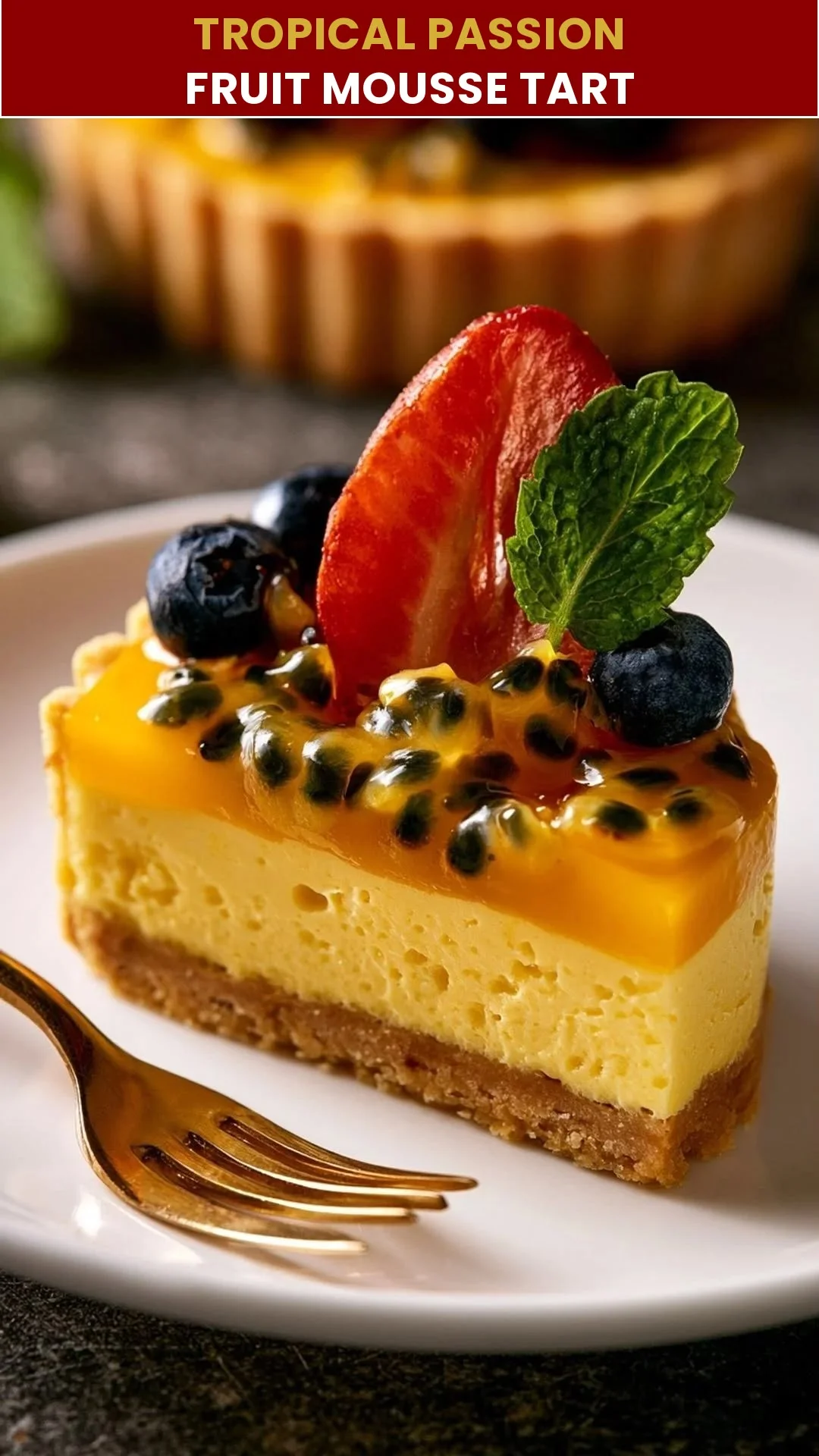
- Stunning visual appeal – The vibrant golden-yellow mousse set in a golden tart shell topped with fresh passion fruit seeds creates a dessert that photographs beautifully.
- Versatile format – You can make one large tart or individual mini tarts depending on your occasion and serving needs.
- Customizable sweetness – Passion fruit is naturally tart, so you control exactly how sweet or tangy you want the finished mousse to be.
- Crowd-pleasing and unique – Most people have never had a passion fruit tart, which means this recipe guarantees memorable reactions at any gathering.
- Meal prep compatible – You can prep the crust, mousse, and toppings in separate stages and assemble when needed, fitting perfectly into a weekly dessert prep schedule.
- Relatively simple technique – Despite looking fancy, the recipe relies on a handful of core techniques – pressing a crust, whipping cream, and setting a mousse – that any home baker can master.
- Impressive and shareable – Whether you’re bringing a dessert to a potluck or posting photos online, this tart is an absolute showstopper every single time.
Health Benefits and Ingredient Highlights
Every ingredient in this Tropical Passion Fruit Mousse Tart plays a specific role, both in flavor and in nutrition. While this is absolutely an indulgent dessert, understanding what’s inside helps you appreciate the balance of richness and bright, natural goodness this recipe delivers.
Passion Fruit
Passion fruit is surprisingly rich in nutrients for such a small fruit. It is an excellent source of vitamin C, which supports immune function and skin health, as well as vitamin A, which benefits eye health and cell regeneration. A single serving of passion fruit also provides a noteworthy amount of dietary fiber.
The fruit contains powerful antioxidants including beta-carotene and polyphenols, which help combat oxidative stress in the body. Research has also suggested that passion fruit seed extract may support cardiovascular health by helping to maintain healthy blood pressure levels. Beyond its nutrition, the fruit’s naturally acidic profile adds brightness to desserts without relying entirely on refined sweeteners.
When you use fresh passion fruit pulp in your mousse, you’re incorporating a fruit that is as nutritionally valuable as it is delicious. This is a small but meaningful way to add natural goodness to what is otherwise a rich, creamy dessert.
Heavy Whipping Cream
Heavy cream is what gives the mousse its signature light, airy, cloud-like texture. When whipped properly, it traps air within its fat structure, creating volume and that melt-in-your-mouth quality that defines a great mousse. The fat content in heavy cream also helps carry fat-soluble flavors from the passion fruit, deepening the overall taste experience.
From a nutritional standpoint, heavy cream contains fat-soluble vitamins including vitamin A, D, E, and K2. It is also a source of conjugated linoleic acid, or CLA, which some research suggests may have modest metabolic benefits. Because you use it in a mousse format where it’s whipped to high volume, a little cream goes a long way in terms of richness and satiety.
Cream Cheese
Cream cheese acts as a stabilizing base for the mousse, giving it body and structure so it holds its shape in the tart shell. It adds a subtle tangy richness that complements the acidity of the passion fruit beautifully. Without it, you’d have a mousse that’s too soft to slice cleanly.
Cream cheese also provides a small amount of protein and calcium per serving. It is lower in lactose than many other dairy products, making it slightly easier to digest for those who are mildly lactose sensitive. Using full-fat cream cheese here is important because it delivers the best texture and stability in the final mousse.
Gelatin
Gelatin is what turns a soft mousse into a sliceable, structured filling that holds its shape in a tart. It is derived from collagen, which is the most abundant protein in the human body, and it supports joint, skin, and gut health. Using gelatin in desserts is a centuries-old technique that predates modern food science by hundreds of years.
Beyond its structural benefits, gelatin is virtually calorie-free in the small quantities used in this recipe. For those who prefer plant-based alternatives, agar-agar can be substituted and works just as well for setting the mousse. The key is blooming your gelatin properly before incorporating it – more on that in the instructions.
Digestive Biscuits or Graham Crackers
The tart shell uses crushed biscuits combined with melted butter, creating a pressed crust that is crisp, buttery, and richly flavored. This style of crust is easier to execute than a traditional pastry crust and requires zero blind baking. It also provides a satisfying textural contrast against the smooth, airy mousse.
Digestive biscuits contain whole wheat flour, which adds a touch of fiber to the crust. While the crust is undeniably indulgent thanks to the butter, it also delivers that satisfying crunch that keeps every bite of this tart interesting. You can experiment with different base biscuits to shift the flavor profile of the crust entirely.
Condensed Milk
Sweetened condensed milk adds a deep, caramel-like sweetness to the mousse that balances the sharp acidity of the passion fruit perfectly. It also contributes to the creamy, smooth mouthfeel of the finished filling. Because it’s already sweetened, it reduces the need for adding extra refined sugar to the recipe.
Condensed milk provides calcium, phosphorus, and B vitamins from the dairy base. It is quite calorie-dense, which is why the recipe uses it in controlled amounts to achieve the right level of sweetness without making the mousse overly heavy. If you prefer a less sweet mousse, you can reduce the quantity slightly and compensate with a little extra passion fruit pulp.
Ingredients
This recipe makes one 9-inch tart, serving approximately 8-10 slices. For individual mini tarts, the same quantities will fill about 8 to 10 small tart shells.
For the Tart Shell
- 2 cups (200g) digestive biscuits or graham crackers, finely crushed (use gluten-free biscuits for a GF version)
- 6 tablespoons (85g) unsalted butter, melted (use vegan butter for a dairy-free crust)
- 2 tablespoons (25g) granulated white sugar
- 1/4 teaspoon fine sea salt
For the Passion Fruit Mousse
- 1/2 cup (120ml) fresh passion fruit pulp, strained (from approximately 8-10 ripe passion fruits, or use canned passion fruit pulp as a substitute)
- 2 tablespoons (30ml) cold water, for blooming gelatin
- 1 tablespoon (10g) unflavored gelatin powder (substitute: 1 tablespoon agar-agar powder for a vegan/vegetarian version)
- 8 oz (225g) full-fat cream cheese, softened to room temperature (substitute: mascarpone cheese for a richer flavor)
- 1/2 cup (160g) sweetened condensed milk (substitute: coconut condensed milk for a dairy-free option)
- 1 tablespoon (15ml) fresh lemon juice or lime juice
- 1 cup (240ml) heavy whipping cream, cold (substitute: full-fat coconut cream for dairy-free)
- 3 tablespoons (35g) powdered sugar (adjust to taste)
- 1 teaspoon pure vanilla extract
For Topping
- Pulp from 3-4 fresh passion fruits (for spooning over the top)
- Fresh mint leaves, for garnish
- Toasted coconut flakes (optional, for added tropical flair)
- Edible gold leaf or gold dust (optional, for an elegant finish)
Step-by-Step Instructions
Follow these steps carefully and you’ll end up with a flawless Tropical Passion Fruit Mousse Tart every single time. Read through the entire recipe before you begin so there are no surprises along the way.
- Crush the biscuits. Place your digestive biscuits or graham crackers in a zip-lock bag and crush them using a rolling pin until they resemble fine crumbs. Alternatively, use a food processor for a faster and more uniform result. You want very fine crumbs with no large chunks remaining.
- Make the crust mixture. In a medium mixing bowl, combine the crushed biscuits, melted butter, granulated sugar, and sea salt. Stir everything together until all the crumbs are evenly coated in butter and the mixture holds together when you press a small amount between your fingers.
- Press the crust into the tart pan. Transfer the crust mixture into a 9-inch loose-bottomed tart pan. Use the flat bottom of a glass or measuring cup to press the crumbs firmly and evenly across the base and up the sides of the pan. Make sure the edges are well pressed and uniform in thickness.
- Chill the tart shell. Place the pressed tart shell in the refrigerator for at least 30 minutes, or in the freezer for 15 minutes. This helps the butter set and firms up the crust so it doesn’t crumble when you add the mousse filling.
- Bloom the gelatin. Pour the cold water into a small bowl and sprinkle the gelatin powder evenly over the surface. Do not stir. Let it sit undisturbed for about 5 minutes until the gelatin has absorbed the water and looks swollen and spongy. This process is called “blooming” and it ensures the gelatin dissolves evenly.
- Dissolve the gelatin. Microwave the bloomed gelatin for 10-15 seconds in short bursts until it has fully melted into a clear liquid. Alternatively, place the bowl over a pot of simmering water and stir until dissolved. Do not let the gelatin boil, as boiling can destroy its setting properties.
- Strain the passion fruit pulp. If using fresh passion fruits, cut them in half and scoop the pulp into a fine-mesh strainer set over a bowl. Use the back of a spoon to push the juice through the strainer, discarding the seeds. If you prefer to include some seeds for texture and visual appeal, leave a small handful in the strained pulp.
- Combine gelatin with passion fruit. Add the dissolved gelatin liquid to the strained passion fruit pulp and whisk them together until fully combined. Set this mixture aside at room temperature while you prepare the rest of the mousse. Do not refrigerate this mixture or it will start to set before you’re ready.
- Beat the cream cheese base. In a large mixing bowl, beat the softened cream cheese using a hand mixer or stand mixer on medium speed until it is completely smooth and fluffy, about 2-3 minutes. Scrape down the sides of the bowl as needed. It’s crucial that your cream cheese is fully at room temperature, otherwise you’ll end up with lumps in your mousse.
- Add condensed milk and citrus. Add the sweetened condensed milk and lemon or lime juice to the cream cheese. Beat on medium speed until the mixture is smooth, creamy, and well combined. The mixture should look silky and uniform at this point.
- Incorporate the passion fruit-gelatin mixture. Pour the passion fruit and gelatin mixture into the cream cheese base. Beat on low speed until everything is fully combined and the color is a uniform vibrant golden-yellow. Set this bowl aside momentarily.
- Whip the heavy cream. In a separate clean, chilled bowl, combine the cold heavy whipping cream, powdered sugar, and vanilla extract. Whip on medium-high speed until you reach firm peaks, meaning the cream holds its shape when you lift the beaters. Be careful not to over-whip into a grainy, butter-like texture.
- Fold the whipped cream into the mousse base. Add half the whipped cream to the passion fruit cream cheese mixture and fold gently using a large spatula. Use a slow, sweeping motion from the bottom of the bowl up and over the top to preserve the air in the cream. Add the remaining half and fold again until the mousse is smooth, light, and airy with no visible streaks.
- Pour the mousse into the tart shell. Remove the chilled tart shell from the refrigerator. Carefully pour and spoon the passion fruit mousse into the shell, filling it right up to the top edge. Use an offset spatula or the back of a spoon to smooth the surface into a perfectly level layer.
- Refrigerate to set. Cover the tart loosely with plastic wrap, being careful not to let the plastic touch the surface of the mousse. Refrigerate for a minimum of 4 hours, but ideally overnight, until the mousse has fully set and holds its shape when sliced.
- Add toppings and serve. Just before serving, spoon fresh passion fruit pulp over the top of the set mousse tart. Add mint leaves, toasted coconut flakes, or any other toppings of your choice. Remove the tart from the pan by pushing up gently on the loose bottom, transfer to a serving plate, and slice with a sharp knife warmed under hot water for clean cuts.
Make It Ahead and Batch Prep Guide
This Tropical Passion Fruit Mousse Tart is one of the most make-ahead-friendly desserts you can prep. The entire tart benefits from resting overnight in the refrigerator, which means making it in advance actually improves the final result rather than compromising it. You’re not just saving time, you’re actively making a better dessert.
For batch prepping, consider making the tart shells in advance as a first stage. Pressed and baked tart shells can be stored in an airtight container at room temperature for up to 3 days or frozen for up to a month. Having pre-made shells in the freezer means you can go from “I want a tart” to a finished dessert in just a few hours, skipping one of the more time-consuming steps entirely.
If you’re prepping for a large event or multiple servings, consider making mini tarts using a mini tart pan set or a muffin tin lined with strips of parchment. Mini tarts are easier to serve at parties, portion-controlled, and they set faster because of their smaller size. You can make a batch of 10-12 mini tarts using the same recipe quantities, and they look absolutely stunning on a dessert table.
The mousse itself can be made separately and stored in an airtight container in the refrigerator for up to 2 days before being spooned into tart shells. This two-stage approach is ideal for busy weeks when you want to spread the prep across multiple days. Add the fresh passion fruit topping only right before serving for the best visual impact and texture. No-Bake Mango Cheesecake Tart
Common Mistakes to Avoid
Even experienced bakers can run into issues with mousse tarts. Here are the most common mistakes and how to sidestep each one completely.
- Using cream cheese straight from the fridge. Cold cream cheese will not beat smoothly and will leave lumps throughout your mousse. Always let it sit at room temperature for at least 30-45 minutes before you begin. Lumpy mousse is the number one avoidable mistake in this recipe.
- Boiling the gelatin. Heating gelatin to a boil destroys its setting protein structure, meaning your mousse will never properly firm up. Always melt it gently over low heat or in short microwave bursts, and check the temperature before adding it to your mousse base.
- Adding hot gelatin directly to cold mousse. If you pour hot dissolved gelatin into cold whipped cream or cream cheese, it can cause the gelatin to seize into stringy lumps. Always let it cool to room temperature before combining it with the other mousse ingredients.
- Over-whipping the cream. Going past firm peaks into stiff, grainy cream makes folding impossible and creates a dense, heavy mousse. Stop whipping the moment the cream holds its shape confidently and no longer looks glossy or wet.
- Not pressing the crust firmly enough. A crust that isn’t compressed tightly will crumble when you try to slice and serve the tart. Press the crumbs firmly and evenly, paying particular attention to the corners and edges where the base meets the sides.
- Not allowing enough setting time. Cutting into the tart before it has fully set results in a mousse that collapses and oozes rather than holding clean, beautiful slices. Give it a full 4 hours minimum in the refrigerator, and overnight whenever possible for the best structure and flavor development.
Notes, Tips and Variations
Substitutions
Fresh passion fruit pulp gives the most intense and aromatic flavor, but frozen passion fruit pulp or passion fruit concentrate works well and is much easier to find year-round. If you use concentrate, reduce the quantity by about a quarter as it is more intensely flavored than fresh pulp. Canned passion fruit pulp from Latin American or Asian grocery stores is another excellent option.
For a vegetarian or vegan set, replace the unflavored gelatin with an equal amount of agar-agar powder. Note that agar sets firmer than gelatin, so you may want to reduce the quantity slightly to maintain a softer mousse texture. Agar also needs to be dissolved in hot liquid rather than cold water, so follow the specific package instructions.
Dietary Variations
To make this recipe dairy-free, substitute the cream cheese with a vegan cream cheese alternative, use full-fat coconut cream in place of heavy whipping cream, and use coconut condensed milk instead of regular condensed milk. The flavor profile will shift slightly toward coconut, which actually pairs beautifully with passion fruit for an extra tropical twist.
For a gluten-free version, use certified gluten-free digestive biscuits or any gluten-free biscuit of your choice for the crust. The mousse filling itself is naturally gluten-free, so only the crust requires modification. Make sure to check the labels on all packaged ingredients for potential gluten cross-contamination.
Cooking Tips
Use a loose-bottomed tart pan for the easiest and cleanest removal. If you don’t own one, you can line a regular tart pan or springform pan with parchment paper to make removal easier. A springform pan works as a good substitute and gives you clean sides on the finished tart.
When folding whipped cream into the mousse base, use a large silicone spatula and work in two stages. The first fold is about evening out the temperature and consistency differences, and the second fold is about achieving that final uniform, airy texture. Rushing this step by stirring rather than folding will deflate the air you worked hard to incorporate, resulting in a denser mousse.
If you want an extra shiny finish on the top of the tart, consider making a simple passion fruit glaze by heating a few tablespoons of strained passion fruit juice with an equal amount of sugar and a tiny pinch of gelatin until dissolved, then pouring a thin layer over the set mousse. This creates a glossy, jewel-like finish that elevates the tart’s appearance dramatically. Lemon Curd Tart with Meringue Topping
Topping Ideas and Flavor Boosters
The beauty of this Tropical Passion Fruit Mousse Tart is that it serves as a perfect canvas for a wide variety of toppings. Here are over ten ideas to inspire you.
- Fresh passion fruit pulp – The most classic and vivid topping; just spoon raw pulp straight over the set mousse right before serving for maximum freshness.
- Toasted coconut flakes – Adds crunch, visual texture, and a complementary tropical flavor that pairs naturally with passion fruit.
- Fresh mango slices – Thin slices of ripe mango arranged in a fan or scattered over the top add color, sweetness, and a beautiful tropical pairing.
- Whipped cream rosettes – Pipe rosettes of lightly sweetened whipped cream around the perimeter of the tart for an elegant, bakery-style finish.
- Fresh kiwi slices – The bright green color contrasts beautifully with the golden mousse and adds a refreshing tartness that complements the passion fruit.
- Passionfruit curd drizzle – Make a quick passion fruit curd and drizzle it artistically over the top for an extra layer of concentrated fruit flavor.
- Freeze-dried passion fruit powder – Dust over the top using a fine sieve for an intense burst of color and flavor with almost zero extra effort.
- Fresh mint leaves – A handful of small mint leaves scattered across the top adds a pop of green, a hint of freshness, and an elegant visual contrast.
- Edible flowers – Scatter edible flowers like viola or nasturtium petals over the tart for a stunning, garden-party-worthy presentation.
- Lime zest – Finely grated lime zest sprinkled over the top adds a fragrant citrus note and beautiful green flecks against the yellow mousse.
- White chocolate shavings – Use a vegetable peeler on a cold block of white chocolate to create delicate curls that add sweetness and visual sophistication.
- Pineapple compote – A warm or room-temperature compote of diced pineapple with a little brown sugar and lime juice spooned alongside each slice adds a comforting warmth to the cool tart.
Who This Recipe Is For
This recipe is designed to work for a wide range of people. Here’s who will love it most.
- Home bakers who want to impress – This tart looks far more professional than its skill level demands, making it ideal for anyone wanting to level up their dessert game without taking a pastry class.
- Dessert meal preppers – If you like to prepare sweet treats at the beginning of the week to enjoy throughout, this tart is a natural fit for your routine.
- Party and event hosts – The make-ahead nature of this tart makes it a stress-free choice for dinner parties, bridal showers, birthday celebrations, and holiday gatherings.
- Tropical flavor lovers – If you gravitate toward bold, bright, fruity flavors and love ingredients like mango, coconut, and citrus, this recipe is tailor-made for your palate.
- No-bake dessert enthusiasts – The mousse filling requires no oven time, and the crust can also be used without baking, making this accessible during hot summers or for anyone without a reliable oven.
- Gluten-free or dairy-free bakers – With simple and straightforward swaps, this recipe adapts easily to gluten-free or dairy-free diets without sacrificing quality or flavor.
- Parents looking for a fun weekend baking project – The steps are approachable enough to involve kids in the crust pressing and mousse-spooning stages, making it a memorable family activity.
- Food photographers and content creators – Honestly, this tart is one of the most photogenic desserts you’ll ever make. The vibrant golden color and dramatic toppings photograph stunningly in natural light.
Storage and Meal Prep Tips
Refrigerator
Once fully set, the Tropical Passion Fruit Mousse Tart can be stored in the refrigerator for up to 4 days. Keep it covered loosely with plastic wrap or store it inside a large airtight container to prevent it from absorbing other food odors. The crust will soften slightly over time due to the moisture from the mousse, but it will still taste excellent through day 3.
If you’ve already added fresh passion fruit topping, note that the seeds and pulp are best when added fresh each time you serve a portion. Store the topping separately in a small jar in the refrigerator and add it right before serving each slice for the freshest appearance and texture.
Freezer
This tart freezes surprisingly well, making it an excellent candidate for long-term dessert prep. To freeze, allow the tart to fully set in the refrigerator first, then remove it from the tart pan and place it on a flat baking sheet in the freezer for 2-3 hours until solid. Once frozen, wrap it tightly in a double layer of plastic wrap followed by a layer of aluminum foil to prevent freezer burn.
The frozen tart will keep in the freezer for up to 6 weeks. When ready to serve, transfer it to the refrigerator overnight to thaw slowly. Do not add fresh toppings until after thawing is complete. The texture of the mousse remains remarkably creamy after freezing and thawing, with only minimal difference from the freshly made version.
Reheating
This dessert is served cold and does not require reheating at any stage. If you’ve stored it in the freezer, simply thaw it in the refrigerator overnight and serve directly from the fridge. For the best mousse texture and cleanest slicing, the tart should always be served well-chilled rather than at room temperature.
If your sliced portions have been sitting out at room temperature for more than 2 hours, it is best to discard them rather than return them to the refrigerator, as the dairy components in the mousse can begin to deteriorate at room temperature. For parties, serve the tart directly from the refrigerator and return any uneaten portions promptly. Coconut Lime Cheesecake Bars
Nutrition Facts
The following nutrition information is estimated per serving based on the recipe making 10 servings from one 9-inch tart. Values will vary based on exact brands and ingredient substitutions used.
| Nutrient | Per Serving |
|---|---|
| Calories | 320 kcal |
| Total Fat | 22g |
| Saturated Fat | 13g |
| Total Carbohydrates | 27g |
| Dietary Fiber | 1.5g |
| Total Sugars | 18g |
| Protein | 5g |
| Sodium | 145mg |
| Calcium | 75mg |
| Vitamin C | 8mg |
Note: These values are estimates only. For precise nutritional data, use a nutrition calculator with the specific brands and quantities of ingredients you use.
FAQs
Can I make Tropical Passion Fruit Mousse Tart without gelatin?
Yes, you can substitute gelatin with agar-agar powder at a 1:1 ratio by weight. Keep in mind that agar must be dissolved in boiling liquid rather than cold water, and it sets firmer than gelatin. You may want to use slightly less agar – around 2 to 3 teaspoons rather than a full tablespoon – to maintain a softer, creamier mousse texture that resembles the gelatin-set version more closely.
Can I use frozen passion fruit pulp instead of fresh?
Absolutely. Frozen passion fruit pulp is an excellent substitute and is widely available in Latin American, Asian, and Caribbean grocery stores. Thaw it completely before using and strain it through a fine mesh sieve to remove any icy crystals or seeds. The flavor is very close to fresh pulp and in many cases, frozen pulp is actually more consistent in flavor because it’s processed at peak ripeness.
Why did my mousse not set properly?
The most common reason for a mousse that won’t set is improperly handled gelatin. If the gelatin was boiled, overheated, or not fully bloomed before dissolving, it loses its setting power. Another reason could be that the gelatin was added to a mixture that was too cold, causing it to seize before it could incorporate evenly. Always ensure your gelatin is fully dissolved, cooled to room temperature, and added to a mousse base that is also at room temperature before folding in the whipped cream.
How far in advance can I make this tart?
You can make the complete Tropical Passion Fruit Mousse Tart up to 2 days in advance and store it covered in the refrigerator. For longer storage, the tart can be frozen for up to 6 weeks as described in the storage section above. The only component that should be added fresh is the passion fruit pulp topping, which is best added no more than 30 minutes before serving to keep the seeds looking vibrant and fresh.
Can I make individual mini tarts instead of one large tart?
Yes, and mini tarts are actually a wonderful option for parties and individual portion control. This recipe makes approximately 10-12 mini tarts using standard 3-inch mini tart pans or a muffin tin. Press the crust mixture into each individual cavity, chill, then fill with mousse and refrigerate as directed. Mini tarts will set faster than a large tart – typically within 2-3 hours – making them a good option when you’re short on time.
Conclusion
This Tropical Passion Fruit Mousse Tart is genuinely one of those recipes that earns a permanent place in your dessert repertoire. It’s elegant enough for special occasions, practical enough for weekly dessert prep, and bold enough in flavor to leave a lasting impression on anyone who tries it. The combination of a buttery biscuit crust and silky, tropical mousse is as close to perfect as a dessert can get.
What makes this recipe particularly special is how approachable it is despite its impressive presentation. You don’t need professional tools, exotic equipment, or years of baking experience. You need good ingredients, a little patience, and the confidence to follow the steps carefully. Everything else takes care of itself.
Give this recipe a try this weekend and let us know how it goes in the comments below. If you made any creative substitutions or added your own topping twists, we’d love to hear about it. Happy baking, and remember – the best desserts are the ones made with love and a little planning ahead.